How Your Dating Profile Creates
First Impressions
Your dating profile is transmitting signals right now — through your photos, your prompts, and the way you communicate once a match happens. The people seeing it are interpreting those signals within seconds. You probably have no idea how they're actually landing.
The SIGNAL Relational Codex™ was built to analyze these patterns more carefully. Instead of looking at photos or prompts in isolation, the Codex looks at how all of your signals work together — and what kind of impression they create as a whole.
If you've experienced strong early connections that lose momentum somewhere along the way, that's not necessarily a compatibility problem. It's often the result of signals creating different expectations on each side without either person realizing it.
You probably recognize the pattern: someone matches, sends a word or two, and then the conversation disappears. A thoughtful message gets a brief reply before the interaction quietly stalls. It feels random, but it usually isn't.
What is often happening is a subtle signal mismatch. Your profile may attract initial curiosity, but the signals it sends about tone, personality, or relational intent don't fully align with how communication unfolds once the match occurs. When that happens, people hesitate, respond cautiously, or disengage — not because they're uninterested, but because they're unsure how to read you.
The match itself may be genuine. The signal just wasn't clear enough to sustain momentum.
This is where signal analysis becomes useful. The question is not simply whether people match with your profile, but what your profile is actually communicating once they do.
Why Your Dating Profile
Isn't Getting Matches
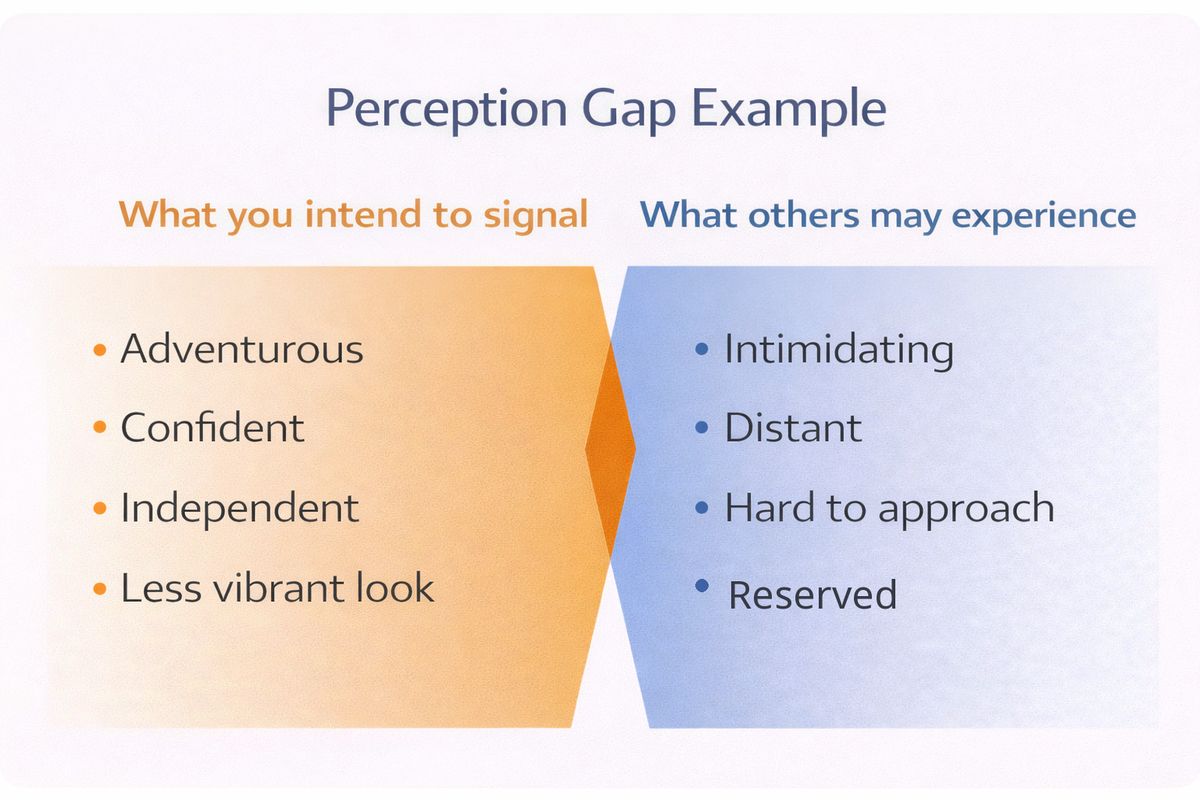
Many of the people who run into this are thoughtful, intelligent, and very intentional about how they live their lives. Ironically, those same qualities can sometimes widen the perception gap. Analytical people tend to approach their profiles logically: they explain exactly what they want, clearly list their interests, and choose photos that feel like accurate representations of themselves.
The challenge is that dating profiles aren't processed logically. They're read quickly, emotionally, and visually — often within just a few seconds. A photo choice, a line of text, or even the timing of a reply can send subtle signals that shape how someone is perceived before a real conversation ever has a chance to develop.
When those signals combine in ways that come across as distant, overly serious, or hard to read, the result can be fewer matches or conversations that stall early. In most cases, the issue isn't compatibility at all — it's simply that what someone intends to communicate and what others actually experience aren't perfectly aligned.
Six Dimensions That Shape
How Your Profile Is Perceived
Each dimension reflects a different layer of how someone is experienced when another person encounters their profile or begins interacting with them. Signal Clarity looks at how clearly and immediately someone's profile communicates who they are. Interpersonal Warmth reflects the signals that communicate openness, friendliness, and emotional approachability. Grounded Authority captures cues of confidence, steadiness, and self-possession without feeling performative or rigid. Navigational Availability reflects how easy or difficult it feels for another person to understand where they stand and how to move toward connection. Alignment Consistency looks at whether the different parts of a profile work together in a way that feels coherent, believable, and aligned. Layered Emotional Pacing reflects the rhythm at which interest, depth, and emotional availability are revealed over time.
None of these signals exist in a vacuum. They play off each other and shape the overall impression someone leaves. The goal is not to be perfect in every area — trying to optimize all six at once usually backfires. The profile ends up feeling overly polished, controlled, or hard to read.
What matters more is balance. A profile that reads a little low on warmth can still work well if it shows genuine expression or tells a coherent story. If someone comes across as very independent or authoritative, even small signals of openness or emotional availability can make the whole profile feel more approachable.
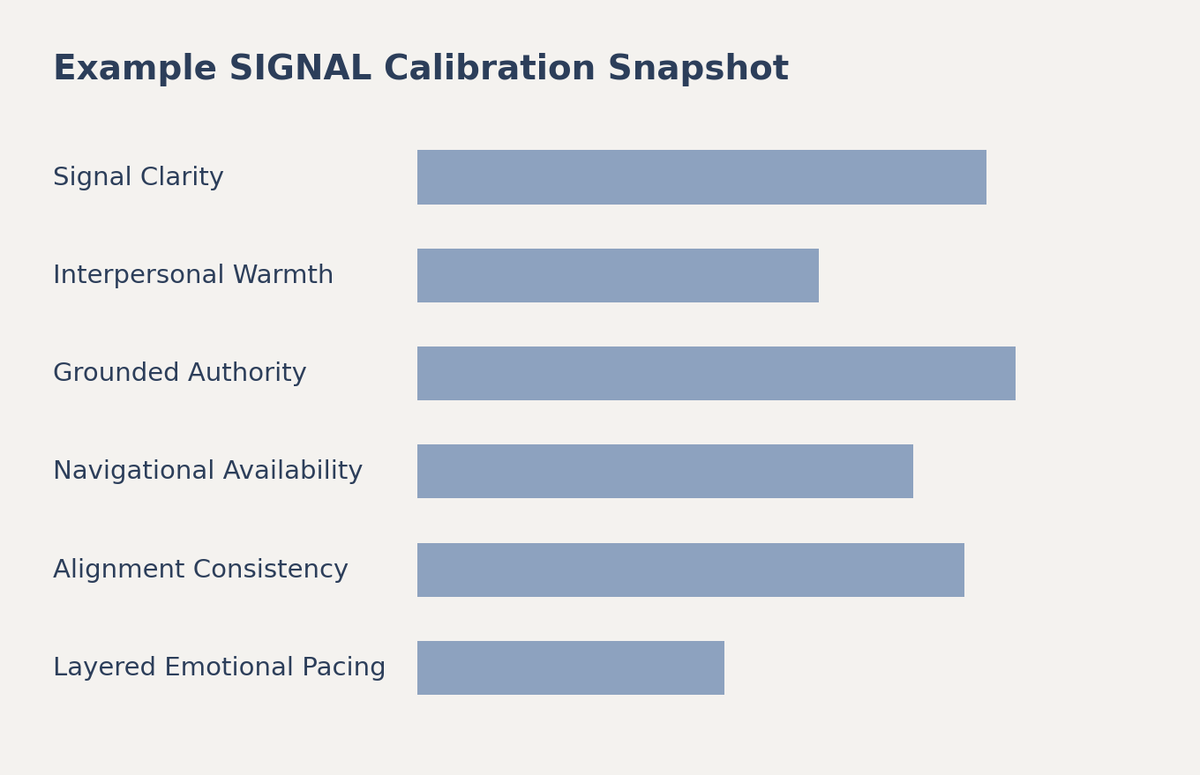
Signals can appear balanced in some areas
while creating perception gaps in others.
How Small Profile Changes
Improve Your Dating Results
People read with their eyes first. Before a single word registers, photos, posture, and tone are already doing the heavy lifting.
Most people assume their profile is fine — it feels accurate to them. But what feels right from the inside isn't always what comes across to someone seeing it for the first time.
Choosing the Right Dating Profile Photos
Accomplished, analytical people tend to choose photos where they look serious or composed. To them, those photos feel professional and confident.
To the person on the other end, that same photo can come across as intimidating or hard to approach.
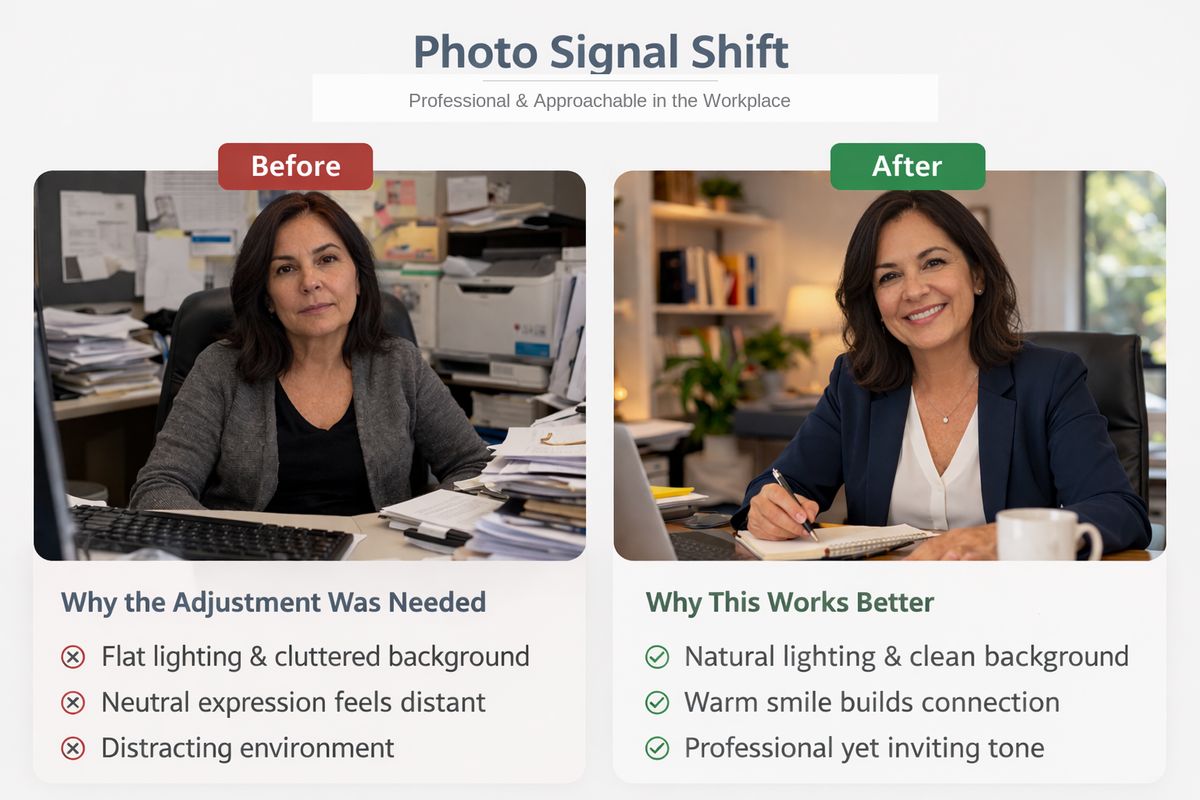
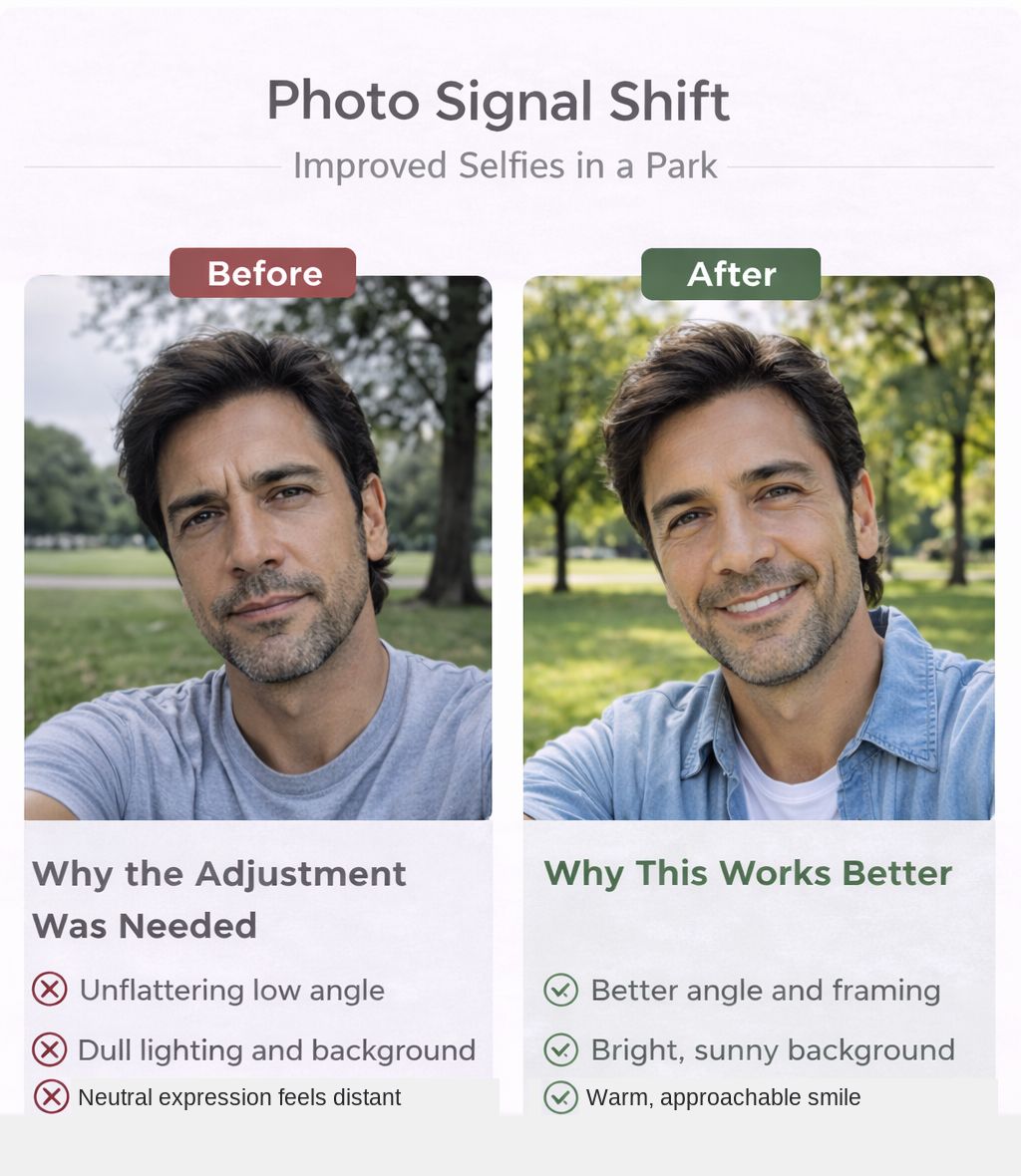
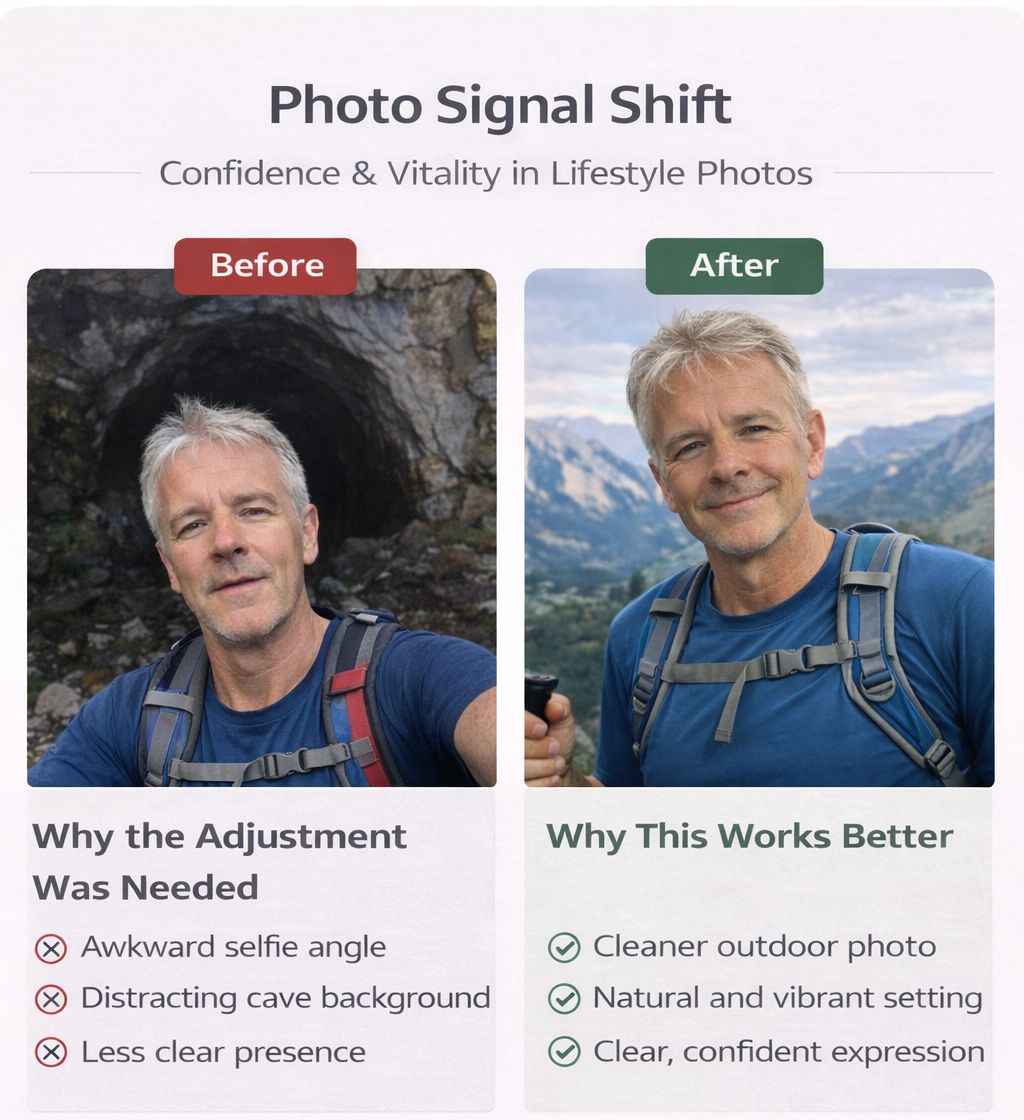
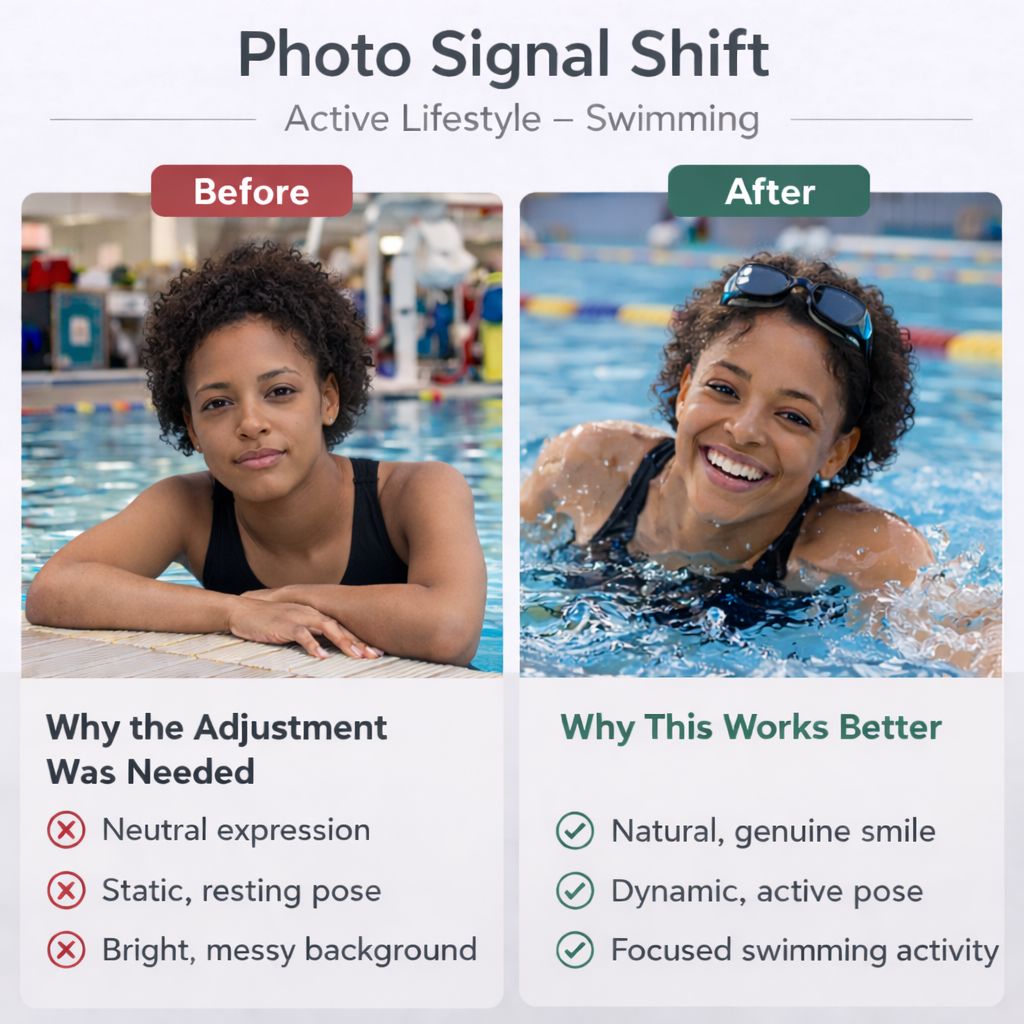
The person hasn't changed. The difference is just how the signal lands. A small shift in expression, lighting, or posture can make someone appear far more approachable — without losing any of their presence or authority.
What's worth noticing is that these small shifts don't just change one thing — they move multiple relational signals at once.
A single photo change can increase interpersonal warmth, sharpen self-presentation, and strengthen narrative coherence all at once. The person is exactly the same — but now the signals are clearer and easier for someone else to read.
This is why the SIGNAL Relational Codex™ looks at profiles holistically rather than analyzing individual elements in isolation.
Writing Dating App Prompts
That Attract, Not Filter
A lot of thoughtful people believe that being very direct about what they want will attract better matches. It makes sense — the goal is to filter for people who are serious.
That directness can sometimes feel like evaluation before any connection has started. Take a statement like:
Example
"I'm only interested in someone serious about a long-term relationship. No games."
The intent is clear — this person values commitment and doesn't want to waste time. In relational signal terms, though, this scores high on Grounded Authority while pulling down Interpersonal Warmth and Navigational Availability. It tells the reader what will be rejected before giving them anything to connect with. Even people who want exactly the same thing may swipe past — the signal feels like pressure, not invitation.
The same dynamic shows up in subtler ways. A prompt like "Successful career, busy life, looking for someone who can keep up" is meant to signal ambition, but it frames the relationship as something the other person has to earn entry into. A joke like "My toxic trait is ordering dessert and not sharing" is lighthearted, but it doesn't say much about who this person actually is — the reader walks away without any real sense of what kind of connection is on the table. In each case, the intent and the perception aren't landing the same way.
The Codex pinpoints these signal dynamics and identifies where a few small changes would bring the profile closer to what the person actually means to communicate.
How Message Timing Affects Online Dating Conversations
Communication timing also sends signals. Two people can show the same level of interest but create very different impressions depending on how they pace their responses.
Two people match and quickly discover they have several things in common. The conversation starts easily and both seem interested. One person responds to every message within seconds throughout the day. The other responds more naturally around work and other responsibilities.
Neither person means to create tension. After a few exchanges, the faster responder starts to feel like the conversation is losing momentum — while the other person begins to feel a subtle pressure to keep up.
Nothing is actually wrong. The difference in pacing quietly introduces uncertainty that wasn't there at the start.
When conversational rhythm develops more naturally — with responses that loosely match the other person's pace — the interaction tends to feel more balanced and easier for both people to continue.
Like photos and wording, pacing quietly shapes how signals are interpreted.
These kinds of small signals are exactly what the SIGNAL Relational Codex™ analysis examines.
Signals Across Platforms
Something a lot of people don't think about is that relational signals don't stop at the dating profile.
Your profile might create one impression, but other signals show up fast after a match. A linked Instagram, the tone of early texts, even how someone suggests meeting up — all of these either reinforce or contradict what the profile originally communicated.
Someone might come across as warm and conversational on their profile, then communicate in short, transactional messages once a match happens. A thoughtful, well-written profile might link to social media that sends a completely different signal about lifestyle or priorities.
The Codex treats all of this as part of a broader pattern. The profile creates the first impression, but the signals that follow often determine whether a connection actually develops.
That broader view is often what explains why some interactions flow naturally while others stall out before they really begin.
What the Codex Doesn't Do
The SIGNAL Relational Codex™ is not about manipulation, scripts, or pretending to be someone you are not.
It doesn't tell people to play games, wait three days to text back, or build some manufactured version of themselves. Honestly, approaches like that usually create the exact kind of signal misalignment that leads to connections falling apart.
The goal is much simpler than that. The Codex helps people see how the signals they're already sending are being read by others. When those signals line up better with who someone actually is, the conversations tend to feel more natural — and the connections that develop tend to be stronger.
Most of the time, nothing about the person needs to change. The adjustments just make it easier for someone else to see what was already there.
Ready to see the signals your profile is sending?
Discover Your Relational Signal